HealthTech — From Access to Intelligence to Augmentation
3 Waves of HealthTech | Value Chain, Dynamics, Concerns

HealthTech has moved from Access to Intelligence, and to Augmentation.
Access: Clucky healthcare experiences that inconvenienced and stigmatised individuals became accessible through destigmatisation and consumerisation. Startups like Hims&Hers and ThirtyMadisons offer repackaged care in consumer-grade experiences, while BetterHelp and Calm reeducated the masses and expanded access to wellness.
Intelligence: LLMs have reframed what has long been the “unsexy” and “neglected” child of healthcare — documentations, workflows, systems. Software that once struggled with unstructured, complex data — clinical notes, imaging reports, and workflows — became operational. OpenEvidence, which just doubled its valuation to $12B in January, and claims that 40% of physicians already use it at the point of care to help rapidly synthesize medical evidence, contextualize clinical decisions, and reduce cognitive load during patient care; EliseAI uses AI to automate patient communication and administrative workflows, handling scheduling, intake, and routine queries across healthcare and senior living; GenPulse develops AI-powered diagnostic tools that provide personalized health insights — beginning with clinical-grade analysis of hair and scalp health.
Augmentation: Beyond optimizing healthcare delivery, these companies ask a deeper question: can intelligence itself be extended beyond biological limits? Bridging biology and computation, companies like Merge Labs, founded by Sam Altman, who just raised at $850M from OpenAI (yes, same founder), declared a future where ultrasound, together with engineered proteins, can detect brain neural activity, restore lost functions, and eventually create a world where humans seamlessly interact with machines.
Some bits are promising, some bits are scary, but the development will affect all of us.
Access, Destigmatization, and Consumerization (Late 2010s)
The first modern HealthTech wave was not clinical — it was cultural, redefining how people accessed and perceived care.
Startups like Hims & Hers and Thirty Madison tackled healthcare problems that were historically stigmatized, inconvenient, or poorly served by traditional systems: hair loss, sexual health, acne, and birth control. These companies didn’t invent new medicine; they repackaged existing care into consumer-grade experiences.
A similar dynamic played out in mental health. Platforms like BetterHelp expanded access to therapy, while wellness apps like Calm and Headspace reduced the stigma around mindfulness and emotional well-being.
As this segment grew rapidly, there are learnings:
Human labor (therapists, clinicians) and goods (medication) remain the bottleneck — Scaling supply in healthcare is tricky because humans and medication are a big part of the service. You provide 1 therapy session to 1 person at 1 time. 1 person requires 1 set of medication. Essentially, 10x growth also requires 10x the labour and goods. It is not software, and it was never meant to have like-for-like margins and economics as SaaS businesses (does not mean it is a bad business; it is just a different business).
Customer Acquisition Cost (CAC) and Churn — CAC: Introducing a relatively new behavioural service (telehealth) in a stigmatised area requires trust. Building this trust through brand building and education requires marketing, and marketing is costly. Questions: How many dollars do you spend to acquire a customer? How fast can you switch your marketing messaging and channels to increase conversion? Do you have to change your target audience? Where does your audience drop off across your touchpoints, and how are you reducing that?
Regulatory arbitrage cap defensibility — Initially, these companies have numerous regulatory arbitrage opportunities because regulators have not yet caught up with policies on telehealth, prescription deliveries, and medical marketing. Over the years, regulators have clamped down on aggressive marketing, state Boards of Pharmacy have increased scrutiny of cross-state shipments, and the FDA has strengthened oversight of compounding pharmacies. All of this has reduced the regulatory arbitrage these companies enjoyed in their early years, narrowing cost advantages and limiting long-term defensibility.
Note: None of these dynamics imply that these companies are bad businesses or lack venture-like outcomes. On the contrary, several have adapted and reinvented their models multiple times, deliberately building defensibility and improving margins as regulatory and market realities evolved. We know these lessons exist because history has played out briefly for us in this wave, unlike in the others below.
Clinical Intelligence and the Unsexy Reality (Early–Mid 2020s)
If human labour, i.e., clinicians, continues to be the bottleneck, how can we optimise the process for both physicians and patients? The next wave shifted focus from patients to the healthcare system itself.
Healthcare’s bottleneck was never delivery care alone — it was cognition, documentation, coordination, and administration. Clinicians spend more time charting than caring; EHRs have fragmented workflows; medical recording and compliance consume enormous economic and emotional bandwidth. All these affect patient outcomes.
However, large language models changed the equation. Unlike prior software, LLMs can process unstructured medical data—clinical notes, discharge summaries, and imaging reports. This unlocked an entirely new category: clinical intelligence.
Products like OpenEvidence exemplify this shift by focusing on evidence synthesis and clinician decision support rather than autonomous diagnosis; Heidi Health provides ambient documentation and clinical note generation; EliseAI automates patient-facing communication, scheduling, intake, and coordination.
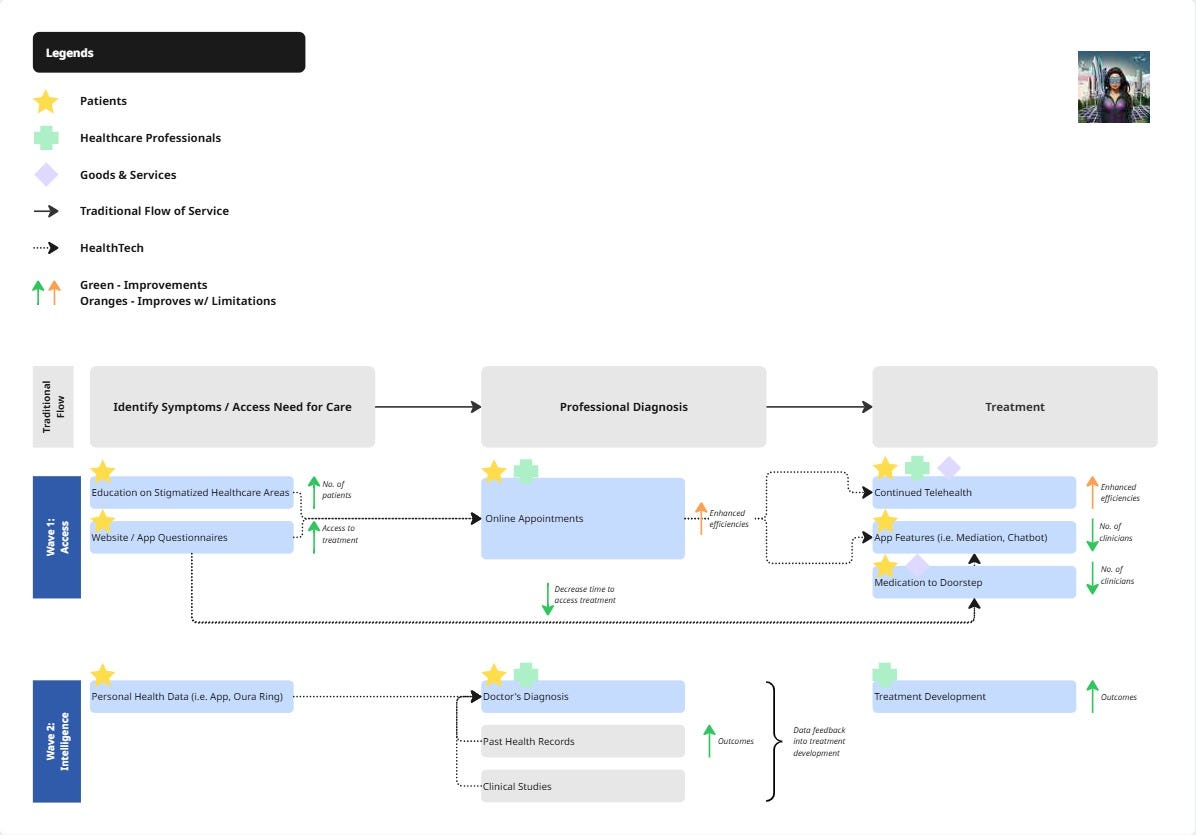
See below for an overview of the HealthTech value chain across the Access and Intelligence waves, and how technology has evolved to drive disruption.
Human Augmentation and Bio-AI Convergence (Emerging Frontier)
Finally, we are in the early and largely pre-commercial stage of bio-AI convergence.
AI-enabled human augmentation startups, including neurotechnology and brain-computer interface companies such as Merge Labs, sit at the intersection of biology and computation. Rather than optimizing healthcare delivery, these companies ask a deeper question: can intelligence itself be extended beyond biological limits?
This category is capital-intensive, regulation-heavy, and long-dated. It more closely resembles frontier biotech than traditional SaaS. Yet its ambition marks a philosophical shift — treating biology as an interface rather than a constraint.